


Compliance and sovereignty: are your technology partners up to the task?
In the field of cybersecurity, the European regulatory landscape has become significantly more complex in recent years. As a result, compliance has logically emerged as a major strategic priority, especially with the NIS2 directive and GDPR. But beyond mere regulatory compliance, the issue of digital sovereignty is now at the forefront for organizations: how can they retain control over their data, infrastructure, and technological future in a globalized world? This dual challenge of compliance and sovereignty makes the selection of technology partners more critical than ever. A poor choice can not only create security and compliance vulnerabilities but also erode part of your strategic autonomy.
Anton Carniaux, General Counsel of Microsoft France, recently confirmed this before the French Senate: even if stored in Europe, your data can still end up in the hands of the U.S. government. The Patriot Act and the Cloud Act require all American tech giants to cooperate, even abroad (source). And while achieving 100% sovereignty may be an illusion today, choosing the right providers can make all the difference.
And while achieving 100% sovereignty may be unrealistic today, choosing the right providers can make all the difference.
Jean-Christophe Budin, VP Product at Weblib, shares the key insights to building a resilient and sovereign partner ecosystem.
Why has vendor selection become so strategic?
Because responsibility has expanded and dependence has increased. In order to limit cases where companies avoid their responsibilities, European regulations are progressively incorporating the principle of cascading liability, with texts such as the GDPR and NIS2, which make you legally responsible for the compliance of your entire supply chain. Each supplier is a link in your own compliance chain, and its strength depends on its weakest link.
But beyond the law, every external partner represents a potential point of control loss. Choosing a vendor is no longer simply about acquiring a functional solution; it’s about integrating a partner whose governance, data location, and exposure to foreign laws you can audit. This is a complex task that, beyond the time and resources it demands, strikes at the very heart of your autonomy.
Concretely, what are the risks if one of my partners is not compliant or sovereign?
“Fines under GDPR and NIS2 are the most visible risk — the tip of the iceberg. But the most damaging consequences — reputational and legal risks — are often more insidious, because they don’t immediately appear on a balance sheet.”
Imagine that one of your critical services (CRM, customer portal…) provided by a partner is found non-compliant, or worse, its data is subject to extraterritorial law. You instantly become a “collateral victim”: your business is directly impacted, but even more seriously, you lose part of the control over your own strategic assets. You are caught in a storm you didn’t cause — but for which you bear the consequences.
And that’s just the beginning. There are cascading risks, very real ones:
-
Operational risk: It’s not just a “service interruption,” but potentially a brutal shutdown that paralyzes your production, sales, or logistics. This is often followed by an unplanned migration, carried out in haste to another solution — at exorbitant cost, with a high risk of failure, and often with the loss of critical data during the transition.
-
Reputational risk: Trust, so hard to build, can be destroyed in an instant. How can you guarantee to your customers that their personal data is protected if it’s hosted outside the EU or by a North American provider, subject to foreign jurisdictions? Even your business partners may reconsider their collaboration, fearing for the security of the global supply chain.
-
Legal and sovereignty risk: This may be the most serious risk of all. Beyond fines, your most strategic data (personal data, customer files, business strategies…) could become legally accessible to foreign authorities through laws such as the U.S. Cloud Act.
“The compliance challenge is not a theoretical threat. It’s a legal sword of Damocles that can open the door to industrial espionage — and cost you your competitive edge.”

How are the right partners the pillars of a digital sovereignty strategy?
Choosing a partner headquartered and primarily operating in France or Europe is now an act of strategic sovereignty. For a European provider, compliance with NIS2 and GDPR is not optional; it’s a matter of survival. More fundamentally, they operate within the same legal and cultural framework as you. This translates into three essential guarantees for your sovereignty:
- Common legal framework: A European player must, for its own security, comply with the local legal framework. We are currently witnessing a tug-of-war between certain American companies, notably supported by Donald Trump, and European regulations; it is increasingly likely that some actors will deliberately evade the application of the law.
-
Data sovereignty: A European partner is, by default, subject to GDPR across all its operations. Its infrastructure is more likely to be located in Europe, shielding your data from extraterritorial requests.
-
Legal sovereignty: In case of disputes or legal questions, you operate within a familiar and shared legal framework. You are not exposed to the uncertainties of a foreign legal system.
-
Technological sovereignty: By choosing a European provider, you help strengthen the continent’s tech ecosystem and reduce dependence on non-European monopolies.
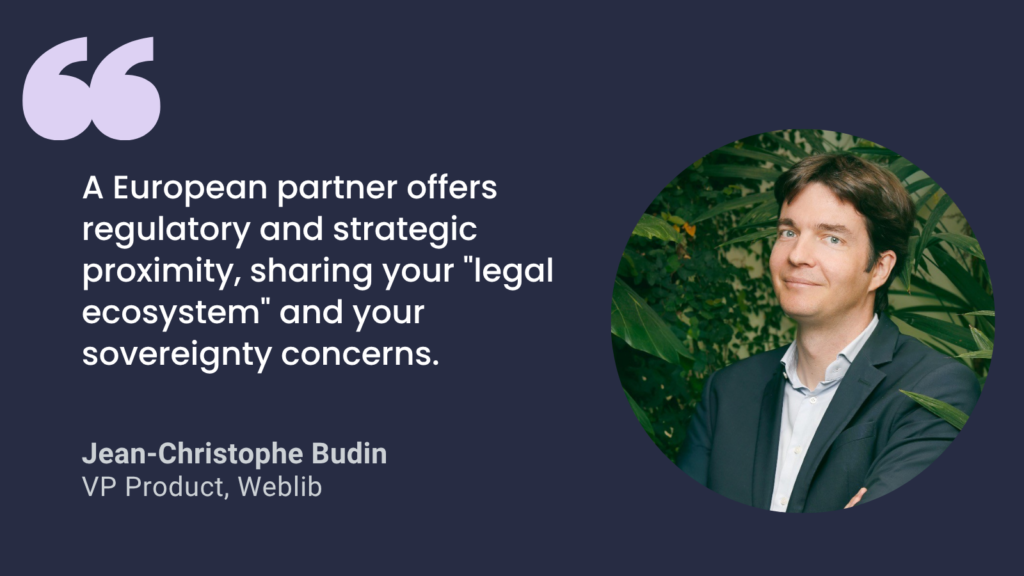
A European partner therefore offers regulatory and strategic alignment, sharing your “legal ecosystem” and your sovereignty priorities.
Beyond origin, how do you recognize a reliable and sovereign partner?
True reliability comes down to a partner’s maturity. An established company with over twenty years of experience (as is the case for Weblib and its Ucopia offering, for example) has had the time to embed security best practices — often long before they became legal requirements. This maturity reflects a long-term vision, because such a partner has already navigated several technological and regulatory cycles. They don’t merely react to the law; they have grown with the principles underlying it: robustness, resilience, and the protection of their clients’ assets. They are a stable pillar on which you can build your compliance and sovereignty strategy.
At Weblib, we believe security and compliance are the foundation of trust and sovereignty. As a long-standing European player, we provide our clients with solutions natively designed for their needs and regulatory environment.
“Choosing Weblib means partnering with a company that didn’t wait for regulatory mandates to adopt security best practices — it’s in our DNA.”
Would you like to discuss this topic with our experts or review your infrastructure? Do not hesitate to contact us.