
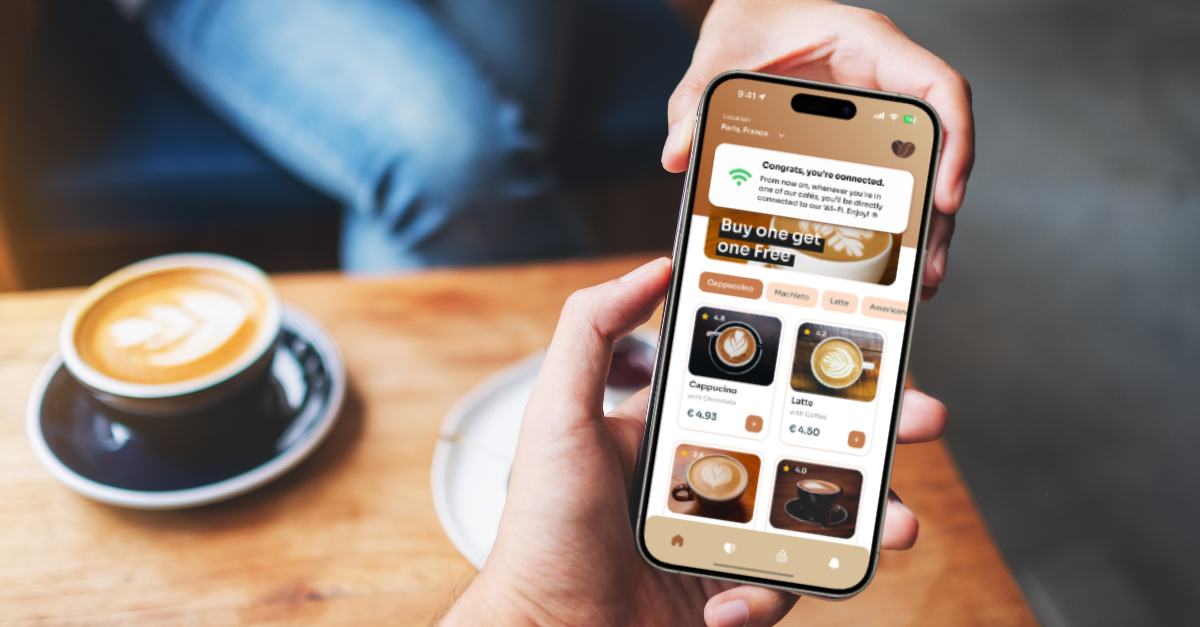

Captive Portals: revolutionize the customer experience with Passpoint
While businesses are investing heavily in the digitalization of their services, the promise of a smooth and unified customer experience is all too often broken in practice. Mobile apps and online journeys, no matter how sophisticated, face a major hurdle: unreliable indoor mobile connectivity. Significant investments can thus be undermined by this final weak link in the chain, creating friction that leads to real customer frustration.
Yet there is a solution to this challenge—one that not only ensures seamless connectivity but also transforms this technical issue into a powerful driver of engagement and revenue. Jean-Christophe Budin, VP of Product at Weblib, shares his vision on this critical issue.

Traditional captive portals and today’s evolving customer expectations
This scenario is familiar to millions of consumers: you enter a store, your 4G/5G coverage is weak or even non-existent, especially in large retail spaces or event halls. You try to connect to the store’s app, but it’s slow. Very slow. It’s not an app issue, but a network problem. You then leave the app to connect to Wi-Fi and go through the connection process. You have to find the right network, fill out a form, accept the terms… and you’ve already lost a lot of time.
The result? Connection rates on these traditional portals rarely exceed a few percent. Indeed, most customers, whether in a hurry or discouraged, give up. This friction creates a major barrier to using your digital services in-store, whether it’s self-scanning, accessing promotions via the app, supplementary content, or navigating to find a product. The customer experience is degraded before it even really begins.
“For any public venue manager, ignoring the issue of indoor connectivity is no longer an option. It’s a strategic challenge that conditions the success of all your digital investments and directly impacts your brand perception.”
False good ideas to improve connectivity
Faced with poor indoor mobile coverage—a recurring problem in modern buildings, basements, or large metal structures that act like Faraday cages—many professionals look for a solution. Unfortunately, they often turn to options that can be ineffective, costly… or even illegal, such as:
-
Signal Boosters: The ultimate DIY solution. Often installed near windows, these devices are not only illegal because they transmit on frequencies you don’t own but also cause significant interference that degrades service quality for the entire neighborhood. Operators actively track these disturbances and don’t hesitate to send formal warnings. It’s a short-term fix that exposes you to regulatory and technical risks.
-
Distributed Antenna Systems (DAS): A very effective solution but unfortunately reserved for large-scale projects. Approved by operators, these systems are genuine infrastructure projects. They are expensive—the entry ticket costs hundreds of thousands of euros—and complex to deploy, requiring coordination with each operator and work that can disrupt store activity. It’s a significant investment out of reach for most retail locations.
“Rather than engaging in a costly, complex, and risky battle to try to fix mobile coverage, the smartest strategy is to capitalize on an asset you already control. Because the most pragmatic and economical solution is right in front of you: optimize your establishment’s existing WiFi network.”

How an optimized WiFi portal can boost your business
This instant, reliable, and seamless WiFi connection removes all barriers to adopting your digital services. Here are a few examples:
-
Retail: Self-scanning via smartphone is an increasingly popular feature, but it requires perfect network coverage. A disconnection in the middle of shopping can prevent adding an item to the cart and cause immense frustration. With an automatic and stable WiFi connection, you ensure a smooth, uninterrupted shopping experience, encouraging adoption of your new services.
-
Quick Service Restaurants: In a food court or restaurant, a customer ordering via an app expects real-time notification when their order is ready. If mobile coverage is lacking inside the establishment, this crucial notification may never arrive, causing dissatisfaction. Automatic WiFi connection ensures the customer receives all information at the right time, improving a key touchpoint of their experience.
-
Tourism and Transportation: In airports, train stations, or theme parks, access to real-time information is essential (gate changes, schedules, maps, etc.). Reliable connectivity not only reassures travelers by providing accurate information but also allows you to offer relevant additional services (promotions in shops, activities, dining) at the most opportune moments of their journey.
The key to a “Zero Contact” WiFi connection
Imagine your customers, upon entering your store, are automatically connected to your WiFi network securely and completely transparently, without any action on their part. No more tedious searching for the right network, no more long forms, no more forgotten passwords. This is exactly what Passpoint technology (also known as Hotspot 2.0) enables. It is a standardized and proven WiFi norm that establishes a trust relationship between the customer’s device and your network.
Unlike open public WiFi, the connection is encrypted end-to-end using security protocols (802.1x), ensuring the protection of your users’ data. For the customer, the experience is as seamless and imperceptible as moving from one mobile cell to another, or from one operator to another while traveling (roaming). Their smartphone manages the network change in the background without any interruption. The customer can then focus on what matters most: their experience in your store.
“The customer installs a secure connection profile only once. This profile, based on the universal Passpoint standard, configures the phone to recognize and trust your WiFi network. After that, the user has no specific action to take: no network search, no password entry, no portal validation. The experience is as simple and reliable as connecting to the WiFi at home.”
Weblib’s App Connect: the turnkey solution
App Connect integrates the power of Passpoint directly into your mobile app. How does it work? From your app, the customer is invited just once to authorize automatic WiFi connection at your stores, and a secure profile is installed on their smartphone. From then on, when the customer enters one of your locations, their device automatically connects to your WiFi network. The benefits for you are multiple:
-
Optimal Customer Experience: You provide perfect, effortless connectivity, increasing usage of your app and digital services.
-
Enhanced Customer Insights: You no longer rely on checkout interactions to engage. You know when a customer enters and leaves your store. You can analyze visit frequency, duration, and even identify visits that don’t convert into purchases.
-
Targeted, Relevant Marketing: Detect a customer’s arrival and trigger relevant push notifications at the best moment. Offer a promotion on their favorite product upon entry, without needing background geolocation permission, simplifying GDPR compliance.
“With App Connect, your WiFi network evolves from a mere convenience to a powerful marketing and engagement tool. You drastically increase the number of connected customers (from a few percent to 30-40% of your app users) and collect valuable data to refine your strategy.”
Would you like to discuss this topic with our experts or review your infrastructure? Do not hesitate to contact us.