

Onboarding of managed devices: boost security and productivity
Remote work, multiple sites, mobility… In today’s professional landscape, connecting a device to the company network for the first time is no longer just a technical step. If poorly managed, this process (onboarding) can quickly turn into an obstacle course for both IT teams and business users, affecting productivity, security, and employee experience.
When optimized, however, it becomes a real performance lever, as Frédéric Kretzer, Head of Product at Weblib, explains.
The complexity of onboarding
A manual or poorly designed onboarding process is a major source of friction for both the technical teams managing it and the employees experiencing it. For IT teams, this translates into a massive drain on time and increasing complexity. Technical support becomes overloaded, spending countless hours guiding users who may be unfamiliar with the technology. Add to this the challenges of remote management—coordinating the configuration and maintenance of hundreds of devices without a centralized tool is nearly impossible—and the picture of an IT team under constant pressure becomes clear.
“As soon as a fleet exceeds fifty devices, manual management becomes a real challenge.”
For employees, the experience is equally negative and often leads to frustration. Every minute spent trying to configure a device is a minute of lost productivity—a significant indirect cost for senior management. Moreover, this laborious first contact with the digital environment permanently degrades the employee experience and casts the IT department in a negative light, far from its role as an efficient service provider for its “internal clients.”
When Onboarding Threatens Productivity and Security
“The consequences of poorly managed onboarding go far beyond simple frustration. They directly impact the performance and security of the entire organization.”
Impact on Productivity and Workload: A new employee struggling to connect is immobilized, unable to start their work and become operational—the productivity impact is immediate. Every hour spent resolving a connection issue is an hour of lost net productivity for the company. This initial inefficiency inevitably affects technical teams, who are constantly solicited for basic support requests—interruptions that distract them from higher-value strategic projects such as strengthening security or optimizing infrastructure.
Impact on Security: This is the most critical point. An unsecured first connection is an entry point for cyber threats. Even before protective layers are installed, vulnerabilities can be introduced. This risk is amplified by remote work, where corporate devices connect to uncontrolled home networks, potentially creating “security breaches” in the information system.

The tangible benefits of an automated approach
By adopting an automated and centralized onboarding solution, an organization gains measurable benefits at all levels. For IT teams, the advantages are immediate and significant. Automating repetitive tasks saves considerable time, freeing administrators for higher-value activities. By replacing manual interventions with scripted processes, the risk of human error is drastically reduced, ensuring a more consistent and reliable configuration across all devices. Centralized management also provides full control over deployed software versions, a key factor for security.
It is therefore crucial to manage the very first connectivity step. The device must be able to access onboarding resources in an unmanaged mode, technically similar to “Guest” or IoT management. Securing this specific entry point then allows the device to transition to MDM (Mobile Device Management) tools for final configuration.
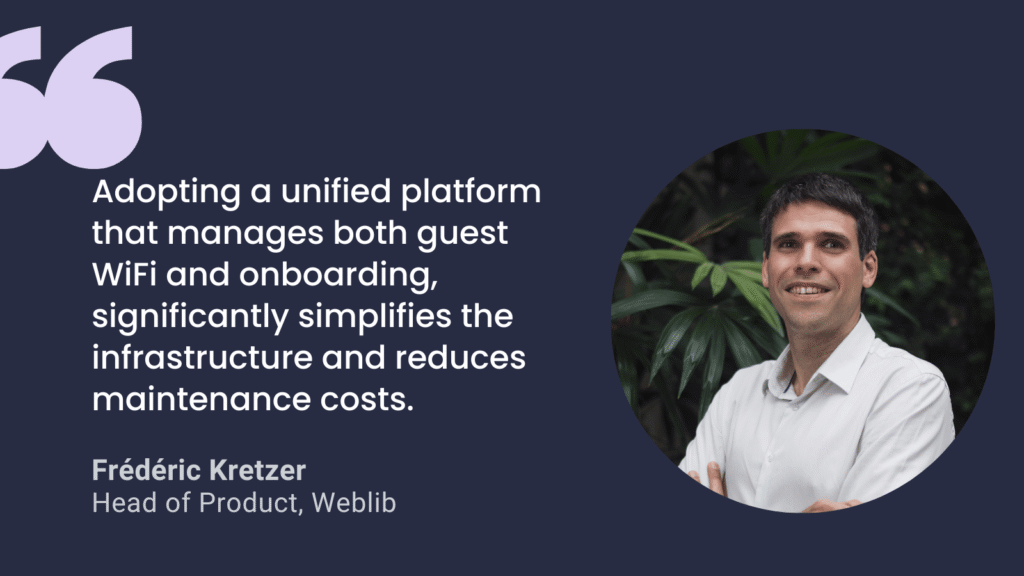
“Furthermore, adopting a unified platform that manages both guest Wi-Fi and onboarding significantly simplifies the infrastructure, reducing complexity and maintenance costs.”
The benefits also positively affect business teams. Employee experience improves thanks to a simple, smooth process that reduces “technological stress” from day one. This simplification notably lowers indirect costs, as less time is wasted on configuration and IT support interventions become rarer. Productivity accelerates: new employees become operational much faster, allowing them to focus on their tasks and contribute to company objectives without delay.
Ucopia’s solution
Ucopia offers a proven approach providing an onboarding process that is both robust and flexible, securing the network without sacrificing user simplicity. Here is the simplified 3-step process:
-
Initial Connection to a Dedicated Portal: The user connects their device to an onboarding-specific SSID, allowing it to be identified.
-
Assignment of a Restricted Profile: Once registered, Ucopia assigns the device an “extremely locked” profile. Network access is limited to only essential configuration resources (specific domains, management servers), minimizing the attack surface.
-
Transition to the Secure Network: Once configuration is complete, the user connects to the enterprise secure network (WPA2/WPA3 with authentication) as defined by company security policies. The device is then fully operational and protected.
Ucopia’s strength lies in its flexibility and ability to adapt to existing infrastructures. The solution is agnostic and integrates natively with major enterprise directories (EntraID, Active Directory, Radius, LDAP), allowing the use of a single reliable identity source without duplicating information. Beyond this essential synchronization, Ucopia enables granular access rules to build a customized security policy. For example, onboarding can be allowed only during office hours to reduce risk outside monitored periods, or different profiles can be assigned based on the user’s group. Its ability to support high device density without compromising user experience makes it ideal for large IT fleets.
“By offering a balance between security, ease of use, and operational efficiency, Ucopia helps transform this critical step into a smooth, controlled process, creating value for both technical teams and employees alike.”
Want to discuss this topic or your infrastructure with our experts? Contact us now for a personalized consultation.